How AI Is Changing Manufacturing: A Map of the Landscape
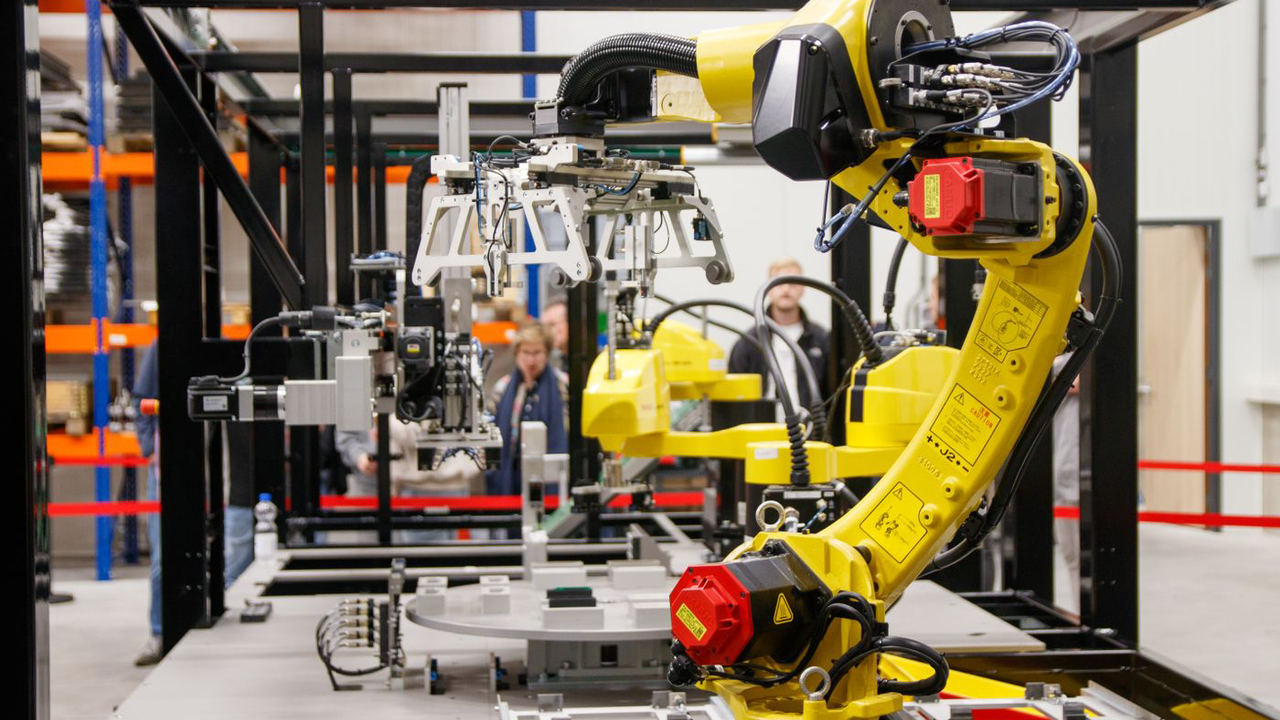
Manufacturing is having an AI moment, but not the one the headlines suggest. The shift isn’t a single magic model. It’s a stack of different AI capabilities quietly threading through every stage of how a product is designed, made, and monitored, enabling custom-at-scale production and smarter factory floors, and steadily lowering the capital barrier to building physical things.
This post is my attempt to draw a map: where this came from, the layers of AI involved, how they connect, and what’s already running on real shop floors. It was prompted in part by a sharp video essay on the topic (How AI is changing manufacturing), which I’ve folded together with the standards and history that give it a backbone.
Where it comes from
AI in manufacturing didn’t appear from nowhere. It sits on roughly seventy years of automation, and two ideas from the last two decades that matter more than any single algorithm.
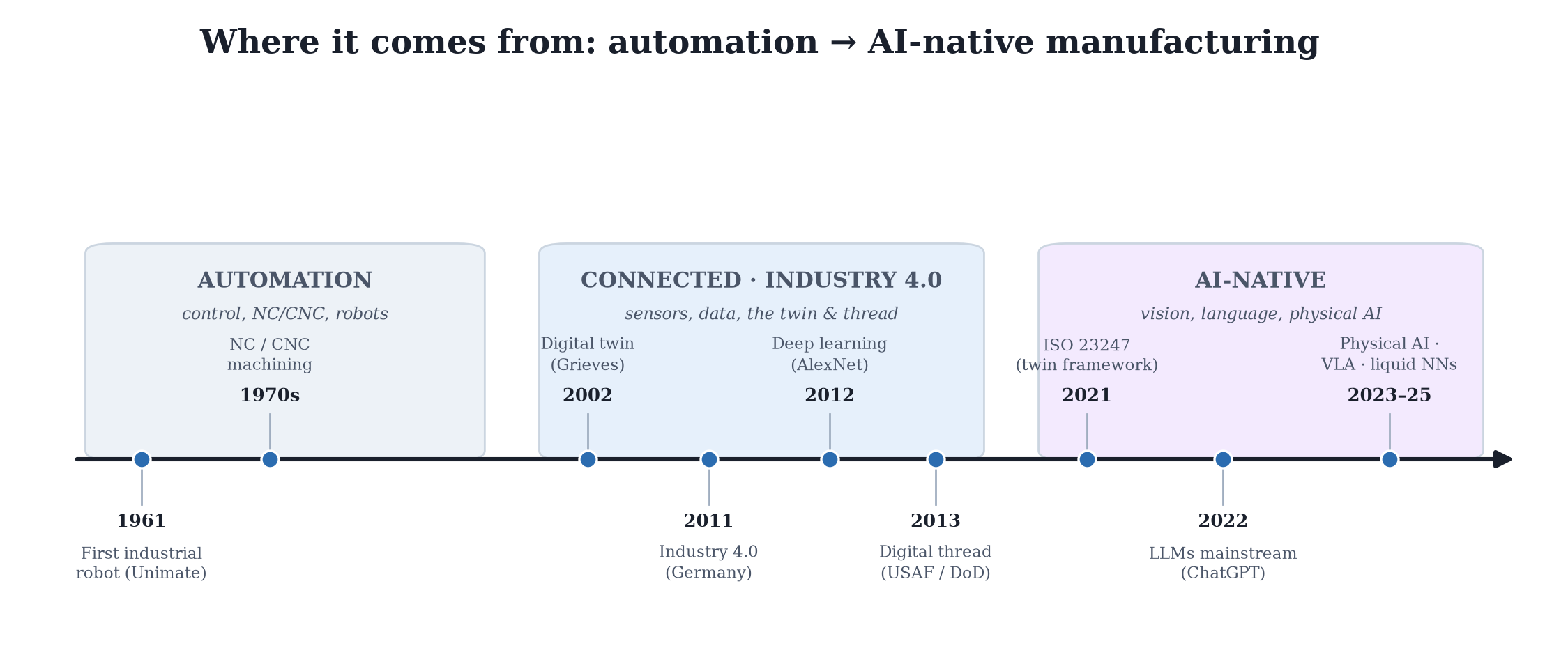 A rough lineage: industrial automation, then the connected “Industry 4.0” era that gave us the digital twin and digital thread, then today’s AI-native layer.
The automation era gave us numerical control, CNC machining, and the industrial robot (Unimate, 1961). These made machines repeatable, but they ran fixed scripts, not judgment.
The connected era added data and two foundational concepts. The digital twin, a synchronized virtual replica of a physical asset, was introduced by Michael Grieves in 2002–2003. The digital thread, the continuous, traceable flow of data linking every lifecycle stage into one authoritative record, was formalized by the U.S. Air Force and DoD around 2013, and now has a manufacturing standards backbone in ISO 23247 (2021). “Industry 4.0,” coined in Germany in 2011, is the umbrella over all of this.
The AI-native era layered modern machine intelligence on top: the deep-learning breakthrough (AlexNet, 2012) gave machines vision; large language models went mainstream (2022) and gave them language; and physical AI, foundation models for robots, is now teaching machines to adapt to the physical world in real time.
The four layers of AI on the factory floor
It helps to stop saying “AI” as one thing. On the shop floor there are really four layers, each adding a different sense to the factory, and they build on one another.
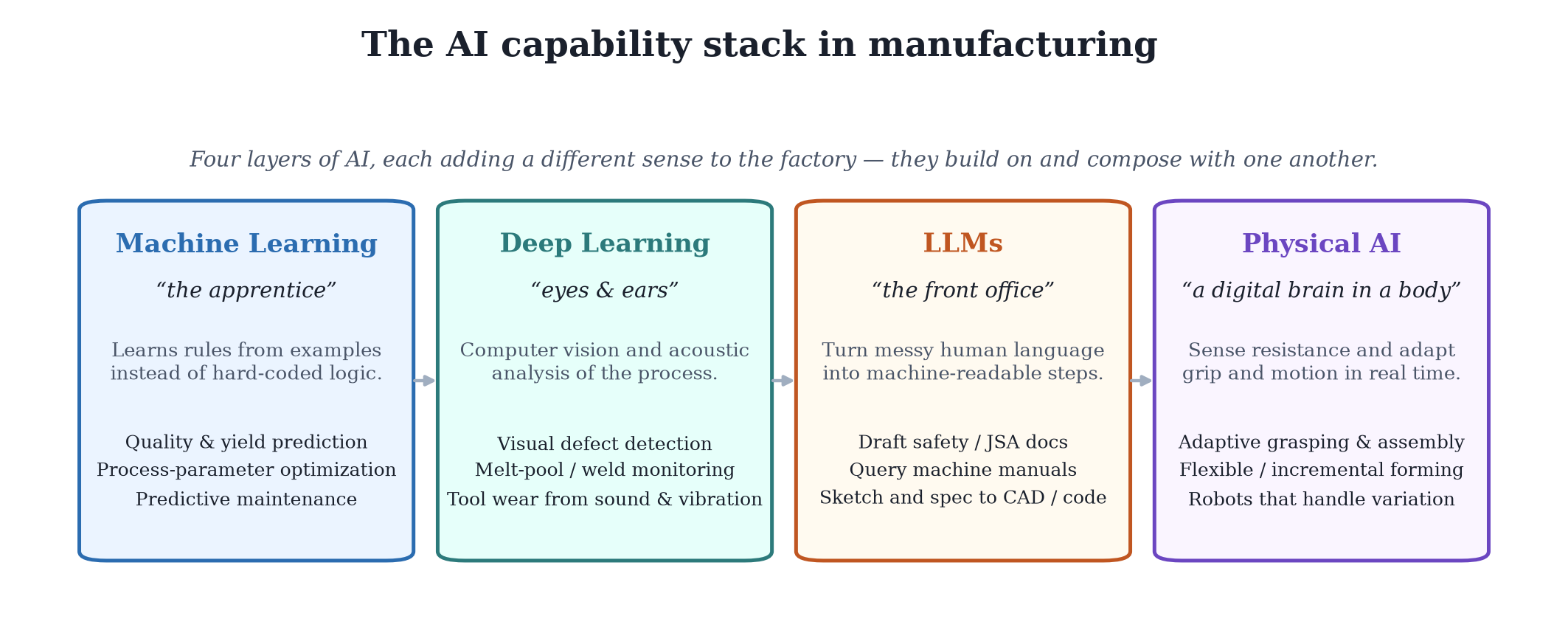 Four layers of AI, each with a different job.
- Machine learning — “the apprentice.” It learns rules from examples rather than from hard-coded logic. In manufacturing: quality and yield prediction, process-parameter optimization, and predictive maintenance.
- Deep learning — “eyes and ears.” Computer vision and acoustic analysis of the process itself: visual defect detection, melt-pool and weld monitoring, and inferring tool wear from sound and vibration.
- Large language models — “the front office.” They translate messy human language into machine-readable steps: drafting safety and job-safety-analysis documents from a machine manual, answering questions about equipment, and turning a sketch or spec into CAD or code.
- Physical AI — “a digital brain in a body.” Robots that sense physical resistance and adapt their grip or motion on the fly, rather than replaying a fixed trajectory. This is the newest and least mature layer, and the most interesting.
How it all connects: the digital thread
The reason these layers matter is that they don’t operate in isolation. They plug into a thread that runs from design intent all the way to a part in operation, and the data flows back around to improve the next cycle.
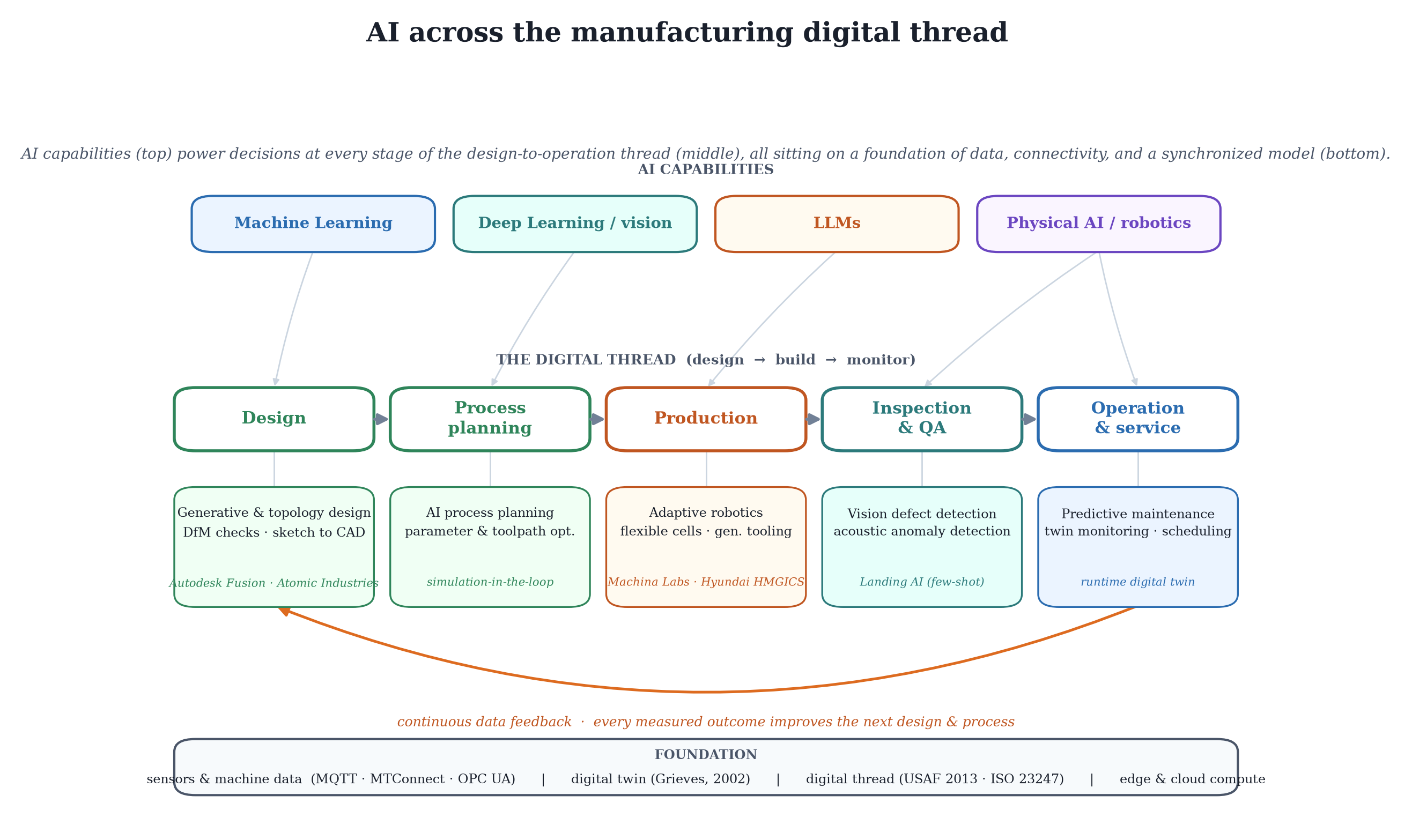 AI capabilities (top) inform decisions at every stage of the design-to-operation thread (middle), all resting on a foundation of data, connectivity, and a synchronized model (bottom).
Read it top to bottom. The capabilities power stages: generative and topology design and sketch-to-CAD at the front; AI-guided process and toolpath planning; adaptive robotics, flexible cells, and generative tooling in production; vision and acoustic inspection for quality; and predictive maintenance and twin monitoring in operation. All of it rests on a foundation of sensor and machine data (carried over protocols like MQTT, MTConnect, and OPC UA), a digital twin, the digital thread, and edge/cloud compute. The orange loop is the point: every measured outcome feeds back, so the system gets better at the next design and the next run. The distinction between a twin (the live model of the thing) and the thread (the connective record tying every stage together) is the single most useful idea here.
Modern applications already in production
The map isn’t speculative. Concrete examples are running today (these are illustrative of the landscape rather than endorsements):
- Automated visual inspection. Tools like Landing AI let a human highlight a defect, a scratch or a chip, in a handful of photos, and a vision model learns to catch it, no enormous labeled dataset required.
- Generative tooling. Atomic Industries uses physics simulation to “grow” conformal cooling channels inside injection-mold tooling that resist warping, geometry a human would struggle to design by hand.
- Adaptive robotics. Research on liquid neural networks (MIT) lets robots move beyond static scripts and adjust to environmental change or human proximity in real time.
- Flexible manufacturing. Machina Labs uses robot pairs for incremental sheet forming, and Hyundai’s HMGICS facility in Singapore runs flexible production cells that assemble different vehicle models on one line, custom-at-scale in practice.
- Connected workflows and coordination. Approaches that link CAD directly to shop-floor instructions mean an engineering change automatically updates assembly steps, and emerging “operating systems” for the factory aim to help disparate robots and machines actually talk to each other.
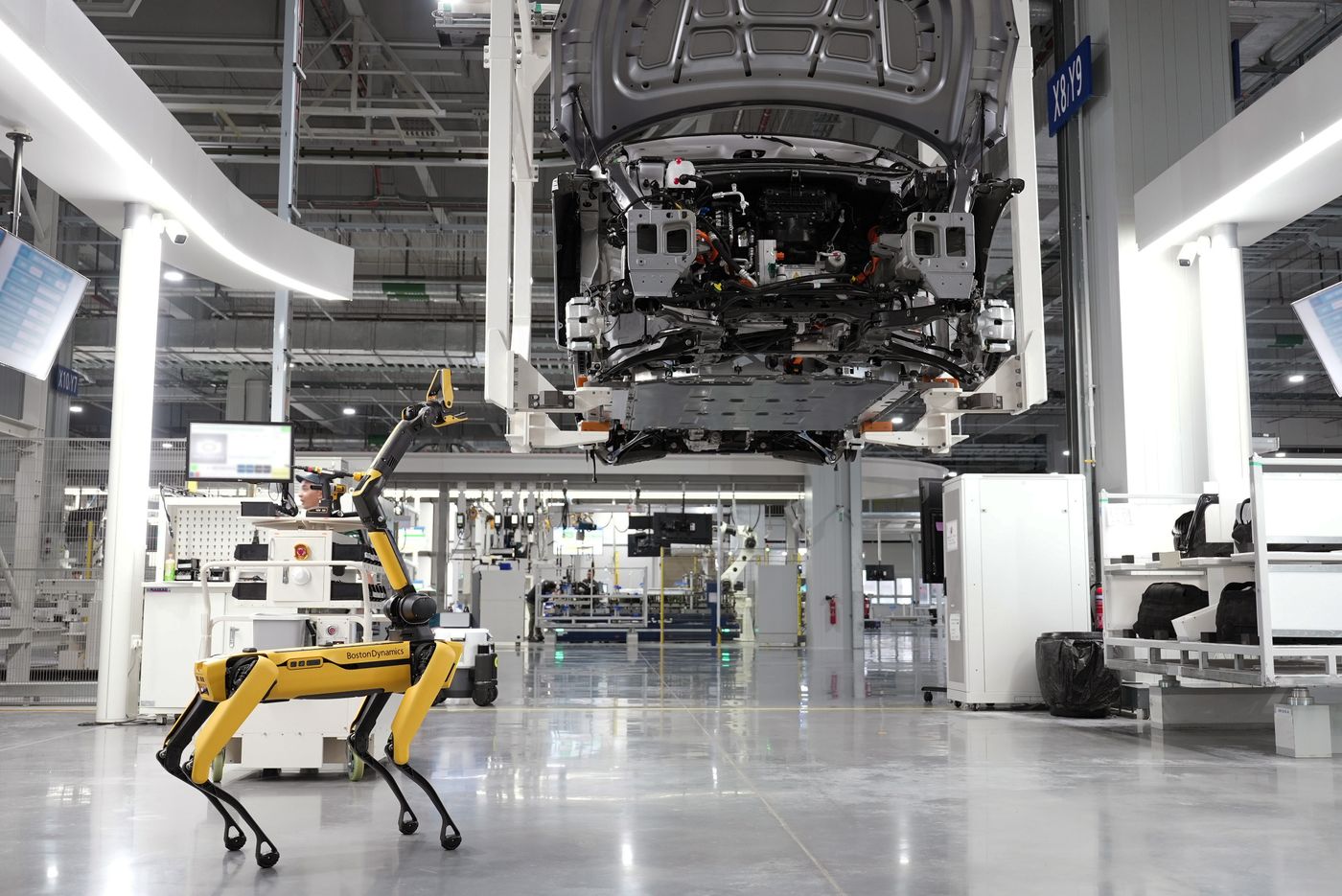 Mobile and legged robots are moving from fixed safety cages onto the open factory floor, navigating and inspecting alongside people. (Photo: Pexels)
A concrete thread I built
To understand the front half of this thread, I built a small, runnable version of it: the Additive Build Advisor. It takes a part geometry, chooses a build orientation, simulates the build, predicts distortion with a real finite-element solve, runs manufacturability and inspection checks, and ends with a gated, machine-readable build record.
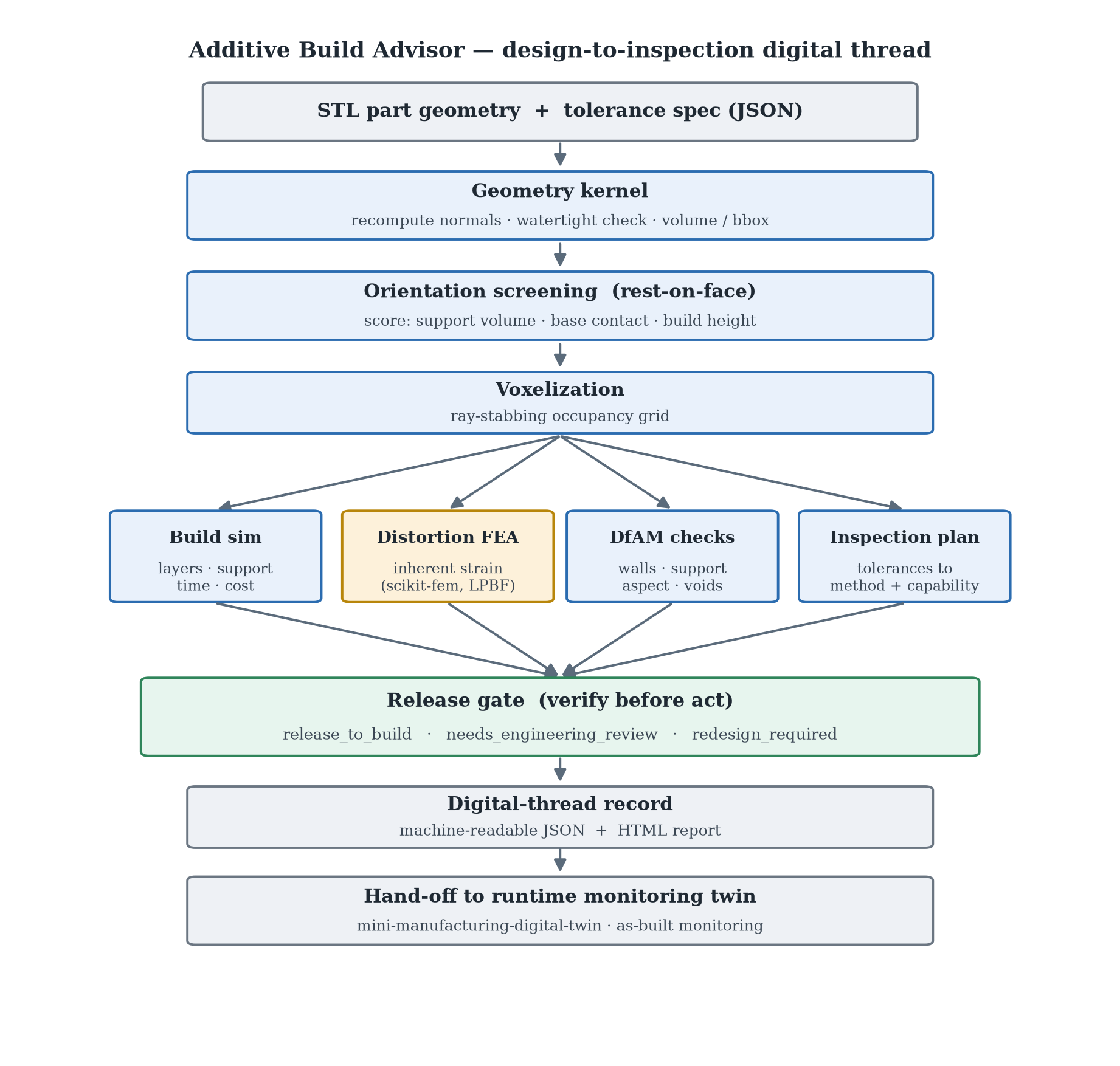 The front half of a digital thread: design intent in, a gated build decision out.
That record then hands off to a runtime digital twin that monitors the process, comparing live telemetry against an expected model and flagging anomalies, the monitor end of the same thread.
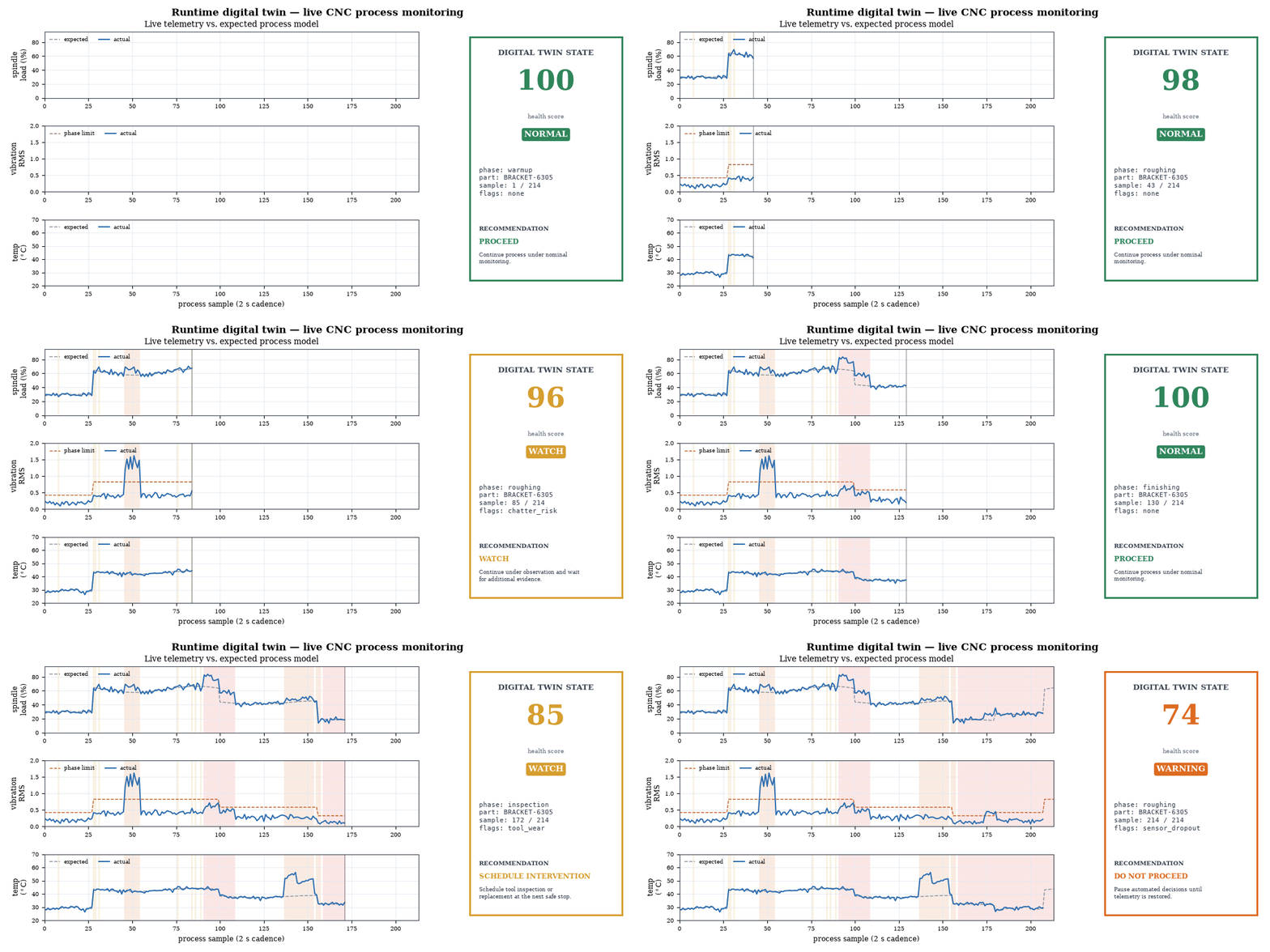 The runtime twin: telemetry vs. expected model, anomaly detection, and a human-in-the-loop recommendation.
Both pieces follow a principle I keep coming back to: verify before you act. The twin refuses to recommend a change when a sensor drops out; the build advisor never silently approves a part. AI proposes, but a confidence gate, or a human, decides.
Where it’s going
The throughline across all of this is that the barrier to building hardware is falling. When AI can help with the design, the robot can adapt instead of being re-scripted, and the data can flow end to end, large capital stops being the sole prerequisite for making things. A good idea and the right digital tools are becoming enough.
The catch, and the part I find most interesting as an engineer, is that none of this works as a black box. The models have to survive contact with real materials, real sensors, and real tolerances, and the useful ones are gated by confidence and kept honest by a human in the loop. That’s the version of AI in manufacturing worth building.
References and further reading
- How AI is changing manufacturing — the video that prompted this map.
- Origins of the Digital Twin Concept — Grieves & Vickers.
- ISO 23247: Digital Twin Framework for Manufacturing.
- NIST analysis of ISO 23247.
- Additive Build Advisor — my own design-to-inspection digital thread.